Submitted by his daughters Julia, Penelope and Hilary.
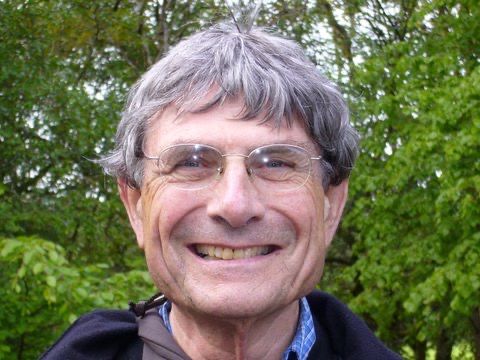
Dr Dinsdale Michael James (Jim) Compton, who attended Christ’s Hospital from 1942-1948, died on January 3, 2026, in Albuquerque, New Mexico, USA.
Aged 11, Jim won a London County Council (LCC) scholarship to Christ’s Hospital. He retained very fond memories of the school throughout his life. Many teachers had returned from the (ongoing) war, and the atmosphere was collegial. Jim liked to tell how he and other students regularly used to push one of the teachers back from the local pub in a wheelbarrow on Saturday nights, after a few too many pints.
Jim particularly valued the teaching of Mr Kirby, the eccentric but brilliant chemistry and biology master. Mr Kirby hadbeen in the Signals Corps in the war, and Jim loved learning signalling from him: everything from Morse code and semaphore to the latest technology. But what most impressed Jim was that Mr Kirby encouraged students to do experiments (often classic historical experiments) without much supervision – often designing their own equipment, and most importantly, without knowing the “correct” answers in advance. Jim and his classmates emerged with huge scientific curiosity and an unparalleled grounding in scientific history and methods.
Jim arrived at CH as “Dinsdale Oliver”, named after the fiery Methodist preacher Dinsdale Young, but took advantage of being confirmed at CH to change his middle names to Michael James. Jim was “impressed with the power of CH”,as he was able to change his passport name with a simple letter from the Headmaster, Dr Bell.
From then on, everyone called him Jim. However, Mr Kirby, who had a nickname for everyone, called Jim “Ukridge”, a rather shady character from PG Wodehouse. Jim thought thismight possibly be because Ukridge’s “glasses are held in place with wire from a ginger beer bottle” (reminiscent of Jim’s own wonky glasses), but it is also possible that Mr Kirby had got confused with a different Wodehouse character,who like Jim, had a stammer.
From CH, Jim got a scholarship to Merton College, Oxford, to study chemistry. At that time, CH often sent promising students to try out Oxford entrance exams a year early, as a ‘practice run’. Jim had originally planned to study biology, but when he got the scholarship, he decided to take it. After graduating with a First, Jim went on to research the frictional charging of liquids (to avert explosions), emerging with a D.Phil. at the young age of 22. Chemistry turned out to be a fine basis for a varied career.
At Oxford, Jim met his first wife, Rosemary, from Leeds, who had a scholarship in Ancient and Modern Languages. They married in 1953 and eventually moved to the USA.
Following post-doctoral research with Canada’s National Scientific Research Institution on organic semi-conductors (the materials now used in hi-tech wearables), Jim worked for IBM in New York State, mostly on the chemistry of transistors underlying early mainframe computers. Jim wasthen recruited as a researcher by General Atomic (GA) in La Jolla, California. In GA, Jim enjoyed working on research projects ranging from Apollo rockets to heart valves. However, when Gulf Oil took over GA, they cut back on research, including cancelling Jim’s pet project on using isotopes to trace pollution from lead (then widely used in petrol). As a result, Jim and other colleagues left GA, and started up several research and consultancy companies – including one developing nuclear isotopes for use in medicine, one for epidemiology on health and safety, and another for environmental health.
Through the start-ups, Jim was involved in applied research on a terrific range of topics, from hospital earthquake protocols and urban sludge management in Mexico, to developing an isotope of fluorine for scanning bones, and improving film editing equipment for Hollywood. Jim always said that he would rather do a bit of everything than to become a distinguished specialist in a single field. He never talked to his family about his scientific accomplishments, but he took out at least seven patents and published more than 30 cited scientific papers. He also inspired all three daughters to study science.
Jim was active and travelled widely into his late 80s. Rosemary was sadly lost to cancer in 1999, and in 2009 Jim married his second wife, Paula, who survives him. After more than 60 years as a “resident alien”, Jim finally got American citizenship in 2021 and voted in his first US election in 2022, at the age of 92. Jim was diagnosed with Parkinson’s Disease in his 90s, but stayed as active as possible and maintained his lively interest in everything, including new research findings. He is much missed.
Jim believed deeply in the benefits of Christ’s Hospital for learning and social mobility, and was committed to fulfilling ‘The Charge’ — that each CH graduate should give back according to their means. He donated generously to CH, including to fund other students, and to many other causes. The family have also requested that anyone who wishes to make voluntary donations in memory of Jim should make them to the bursary fund at CH.